Seawall Repair in Punta Gorda & Port Charlotte, FL
Waterfront properties in Punta Gorda and Port Charlotte can develop seawall problems including soil washout, voids, open joints, cracked caps, concrete deterioration and structural wall movement.
The appropriate next step depends on what is failing, where the property is located and who is responsible for the seawall.
That responsibility question is especially important here. In parts of Punta Gorda Isles and Burnt Store Isles, the City maintains and replaces City-owned seawalls along private canal frontage through dedicated Canal Maintenance Assessment Districts. A Port Charlotte property, by contrast, generally follows Charlotte County’s residential seawall permitting process and does not automatically fall under the Punta Gorda canal-maintenance program.
Punta Gorda and Port Charlotte Are Not the Same Seawall Jurisdiction
Before discussing repair methods, determine which local authority and maintenance system applies to the property.
| Property Location | Important Local Distinction |
|---|---|
| Punta Gorda Isles (PGI) within the applicable canal district | City-maintained canal system includes City-owned seawalls along private canal frontage |
| Burnt Store Isles (BSI) within the applicable canal district | City canal-maintenance program also maintains and replaces applicable City-owned seawalls |
| Other Punta Gorda waterfront property | Do not assume PGI/BSI City seawall responsibility applies; confirm the specific parcel and structure |
| Port Charlotte / unincorporated Charlotte County | Charlotte County has its own residential seawall permit process |
This distinction can completely change the homeowner’s role. A property owner should determine who owns and maintains the wall before commissioning major private structural work.
Common Seawall Problems in Punta Gorda and Port Charlotte
Common warning signs include:
- soil washing out behind the seawall;
- holes or depressions near the waterfront edge;
- sinking pavers or patios;
- voids behind the wall;
- open joints between wall panels;
- cracked or deteriorated seawall caps;
- concrete spalling;
- rust staining;
- exposed reinforcing steel;
- leaning or bowing wall sections;
- panel displacement;
- erosion near the ends of the wall;
- movement or gaps around docks and lifts.
One symptom does not automatically mean the entire seawall needs replacement. The useful question is whether the defect is localized or part of a broader structural problem.
See the warning signs of a failing seawall.
Soil Washout Behind the Seawall
Soil washout can occur when retained material finds a pathway through or around the wall.
Possible pathways include:
- open panel joints;
- cracks or deteriorated wall sections;
- penetrations through the wall;
- erosion around the end of the seawall;
- movement that has opened new gaps.
A common progression is:
Opening or erosion pathway → soil migration → underground void → settlement at the surface
Adding new fill can temporarily hide the depression while leaving the original erosion pathway active.
A more complete repair should identify where soil is escaping and whether support behind the wall also needs to be restored.
Learn more about seawall erosion and soil washout repair.
Voids and Sinking Pavers Behind the Wall
A small surface depression can indicate a larger underground void.
Look for:
- pavers dropping toward the seawall;
- soft or hollow areas behind the cap;
- holes that return after filling;
- gaps beneath slabs or patios;
- settlement near wall joints;
- multiple low areas developing along one section.
The source of the soil loss should be investigated before the surface is simply releveled.
Polyurethane Seawall Repair
Polyurethane injection may be useful for certain void-filling and soil-stabilization conditions behind a structurally serviceable wall.
Potential applications can include:
- filling localized voids;
- restoring support beneath settled areas;
- stabilizing disturbed soil;
- supporting a broader erosion-repair project.
Polyurethane does not replace failed anchors, severely deteriorated seawall panels or other major structural components.
If the wall is leaning or significantly displaced, the structural cause should be evaluated separately.
Learn more about polyurethane seawall repair.
Concrete Seawall Repair
Concrete seawalls can develop localized deterioration without requiring complete replacement.
Common problems include:
- surface cracking;
- wider cracks;
- concrete spalling;
- rust staining;
- exposed reinforcing steel;
- damaged panel edges;
- deteriorated joints;
- panel displacement.
The repair decision depends on the extent of deterioration, reinforcement condition and whether the wall remains structurally aligned.
Learn more about concrete seawall repair.
Cracked Seawall Cap Repair
The concrete cap can deteriorate independently from the vertical wall panels below it.
Cap problems can include:
- cracking;
- spalling;
- rust staining;
- exposed reinforcement;
- broken sections;
- displaced cap segments.
A damaged cap does not automatically mean the entire seawall needs replacement.
Cap deterioration becomes more significant when it occurs together with wall movement, panel displacement or recurring soil loss.
See the seawall cap repair guide.
Leaning or Bowing Seawalls
A visibly leaning or bowing seawall should be treated as a structural condition rather than only a cosmetic defect.
Possible contributing conditions include:
- anchor or tieback deterioration;
- panel damage;
- loss of retained soil;
- changes in loading behind the wall;
- toe or foundation conditions;
- multiple interacting defects.
Some walls may remain candidates for structural stabilization. Others may have deteriorated far enough that partial or complete replacement becomes more practical.
Tieback and Anchor Repair
Many concrete canal seawalls rely on an upland anchor system behind the visible wall.
If a support-system problem is suspected, evaluate:
- amount of wall movement;
- whether movement is progressing;
- panel condition;
- cap condition;
- soil loss;
- existing tie rods, deadmen or other anchors;
- available access behind the wall;
- pools, patios and utilities near the anchor zone.
Installing new support makes the most sense when the wall being supported remains suitable for continued service.
Punta Gorda Isles and Burnt Store Isles Are Different From Ordinary Private Seawalls
Punta Gorda’s canal system includes two dedicated Canal Maintenance Assessment Districts:
- Punta Gorda Isles (PGI); and
- Burnt Store Isles (BSI).
The City states that these districts fund maintenance and replacement of City-owned seawalls lining private canal frontage, along with canal dredging and related canal-system work.
That creates an important first question for a waterfront homeowner:
Is this a privately maintained seawall, or is it part of the City-maintained PGI or BSI seawall system?
Do not hire private structural work on an applicable City-owned canal seawall without first confirming responsibility and the City’s requirements.
Who Pays for Punta Gorda Isles and Burnt Store Isles Seawalls?
The City’s canal-maintenance program is funded through dedicated assessments on properties within the PGI and BSI Canal Maintenance Assessment Districts.
The current City program covers major public canal infrastructure responsibilities including:
- maintenance of applicable City-owned seawalls;
- replacement of deteriorated seawall sections;
- canal dredging;
- mangrove management within applicable district rights-of-way.
This does not mean every item at a private waterfront residence becomes a City responsibility.
Homeowner Responsibilities Along City-Maintained Punta Gorda Seawalls
Punta Gorda’s current canal-maintenance guidance identifies several private-property responsibilities even where the seawall itself is City-maintained.
Property owners remain responsible for maintaining private improvements such as:
- docks;
- pilings;
- boat lifts;
- davits;
- dock lighting;
- water and electrical lines;
- patios;
- pools;
- walkways;
- landscaping;
- irrigation systems.
Owners are also expected to avoid activities that compromise the seawall, tie rods or deadmen.
What Happens When the City Replaces a Canal Seawall?
When applicable City-maintained seawall work reaches a private canal frontage, the homeowner may need to prepare the property before construction.
Depending on the work zone, private items such as docks, lifts, walkways, irrigation equipment, fences, landscaping or other improvements may need to be cleared or modified.
The City’s current guidance states that private-property restoration beyond the City’s stated work scope remains the owner’s responsibility.
This is another reason to determine responsibility before treating a Punta Gorda Isles seawall as an ordinary privately owned repair project.
Do Not Attach Structures Directly to Punta Gorda City Seawalls
Punta Gorda has particularly clear rules intended to protect its public seawall infrastructure.
The City’s current waterfront guidance prohibits structures and accessory objects from being attached to, resting against or passing through applicable seawall caps or panels.
Examples identified by the City include:
- cleats;
- tie-off anchors;
- ladders;
- handrails;
- brackets;
- plumbing;
- electrical conduit.
Docks, pilings and boat lifts must be freestanding rather than structurally dependent on the City seawall.
This is a Punta Gorda canal-system rule and should not be generalized as a statewide Florida seawall requirement.
Punta Gorda Canal Construction Special Permits
Punta Gorda regulates marine improvements along the canal system under its waterfront-development rules.
A dock, lift, walkway or other marine accessory that is not permitted by right can require a Canal Construction Special Permit and review through the applicable canal advisory process.
This reinforces the need to treat the seawall, dock and lift as related waterfront infrastructure while still identifying each structure separately in the project scope.
Punta Gorda Maintains an Active Seawall Assessment Program
The City performs ongoing condition assessments of its canal seawall system and uses those assessments to prioritize maintenance and replacement.
For an applicable City-owned wall, homeowners who notice significant deterioration should therefore report the condition through the City’s canal-maintenance process rather than assuming they must independently commission complete replacement.
Useful conditions to document include:
- new panel movement;
- erosion behind the wall;
- fallen or displaced wall sections;
- cap deterioration;
- rapidly changing settlement;
- damage affecting nearby private structures.
Port Charlotte Seawall Permits
Port Charlotte is generally handled through Charlotte County rather than the City of Punta Gorda canal-maintenance system.
Charlotte County currently has a dedicated Residential Seawall permit category for installation of a seawall at a residential property.
The County’s current permit requirements can include:
- a construction permit application;
- accessory-structure documentation where applicable;
- signed and sealed drawings, plans or engineering;
- a site plan;
- a survey;
- a recorded Notice of Commencement where the applicable contract threshold is met;
- external agency approval where applicable.
The County’s current seawall application also distinguishes between new and repair work and collects information such as the wall’s linear footage, material, waterbody and job access.
Charlotte County Reviews More Than the Wall Structure
The current County seawall process can involve several review disciplines.
- Building: structural compliance, including applicable wind and flood loads;
- Natural Resources: potential protected-species and environmental issues;
- Right-of-Way: impacts to County rights-of-way or easements;
- Zoning: setbacks and land-development requirements.
The County also identifies possible Florida Department of Environmental Protection and U.S. Army Corps of Engineers approvals in its current seawall permit materials.
See the Florida seawall permit guide.
Manmade Canal vs. Other Waterbodies in Port Charlotte
Charlotte County’s seawall application asks whether the project is located on a manmade canal and identifies the waterbody involved.
That distinction matters because Port Charlotte includes extensive residential canal frontage as well as properties associated with larger natural waterways.
Before planning a repair or replacement, document:
- the waterbody;
- existing wall alignment;
- wall material;
- length affected;
- dock or boat-lift location;
- shoreline vegetation;
- water access;
- possible state or federal jurisdiction.
Docks and Boat Lifts in Port Charlotte
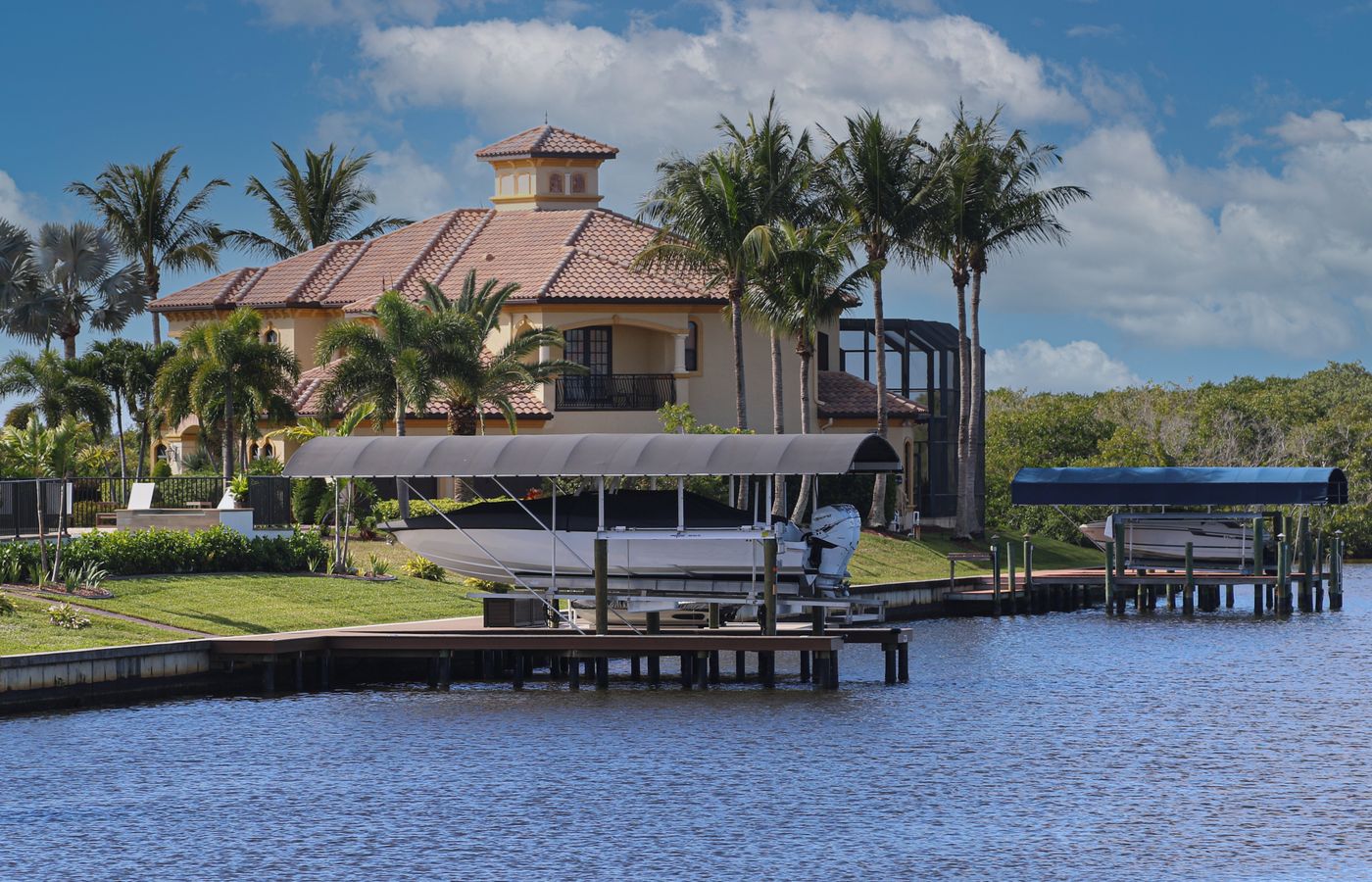
Charlotte County treats docks and boat lifts through their own permit categories, so they should not automatically be assumed to be covered by a seawall permit.
A seawall project may need to account for:
- dock pilings;
- lift supports;
- decking;
- electrical or water service;
- access to wall panels;
- temporary removal or modification of private marine improvements.
The full marine scope should be identified before permit documents and construction sequencing are finalized.
Docks and Lifts Along Punta Gorda City Seawalls
The distinction is even more important in the Punta Gorda canal-maintenance districts because docks and lifts are private structures while the applicable seawall can be City-owned.
That means:
- the seawall and dock can have different responsible parties;
- private structures may need modification when the City performs seawall work;
- docks and lifts must remain freestanding under the City’s current waterfront rules;
- private accessories should not compromise the seawall or its structural supports.
Repair or Replace?
For a privately maintained wall, visible deterioration does not automatically mean full replacement is necessary.
Repair may remain practical when:
- soil loss is localized;
- open joints can be corrected;
- voids can be stabilized;
- cap damage affects limited sections;
- concrete deterioration is localized;
- structural support can be restored;
- most of the seawall remains serviceable.
Replacement becomes more likely when:
- wall movement is substantial or continuing;
- many panels are deteriorated or displaced;
- multiple structural components are compromised;
- previous repairs repeatedly fail;
- too little sound wall would remain after another repair.
For an applicable City-owned PGI or BSI seawall, however, begin by determining the City’s maintenance responsibility and reporting the condition rather than independently applying a private repair-versus-replacement framework.
Use the Florida seawall repair vs. replacement decision guide.
Seawall Replacement in Punta Gorda and Port Charlotte
Replacement can involve much more than installing new wall panels.
A private replacement project may need to address:
- existing wall condition;
- replacement alignment;
- wall material;
- anchors or tiebacks;
- cap construction;
- backfill and drainage;
- docks and boat lifts;
- land-side and waterside access;
- engineering;
- local permitting;
- state or federal authorization where applicable.
For PGI and BSI City-maintained seawalls, use the City’s canal-maintenance and replacement process rather than assuming the homeowner should privately reconstruct the public seawall.
Learn more about seawall replacement in Florida.
How Much Does Seawall Repair Cost in Punta Gorda or Port Charlotte?
There is no reliable single local seawall repair price per linear foot.
For privately maintained walls, cost can depend on:
- repair type;
- length actually affected;
- soil loss and void size;
- concrete condition;
- cap deterioration;
- wall movement;
- anchors or tiebacks;
- land access;
- water access;
- docks or lifts;
- engineering;
- permitting.
For an applicable City-owned PGI or BSI wall, the more important first question is not the private contractor price per foot—it is whether the work is part of the City canal-maintenance program funded through the applicable assessment district.
See the Florida seawall repair cost guide.
What to Check Before Requesting a Seawall Estimate or Reporting Damage
- Confirm the property jurisdiction. Determine whether the parcel is inside Punta Gorda or unincorporated Charlotte County.
- For Punta Gorda, confirm the seawall responsibility. Determine whether the wall is part of the City-maintained PGI or BSI canal system.
- Photograph the complete wall. Include damaged and apparently serviceable sections.
- Document soil loss. Photograph voids, holes and sinking pavers.
- Inspect wall joints. Look for openings or sediment movement.
- Inspect the cap. Note cracking, spalling and displacement.
- Check wall alignment. Photograph leaning or bowing sections.
- Include docks and lifts. Show how private marine structures interact with the seawall.
- Document access. Note pools, patios, landscaping and narrow side yards.
- Note previous repairs. Recurring deterioration can help identify an unresolved cause.
Learn what should be checked during a seawall inspection.
When Should the Seawall Be Evaluated?
Consider closer evaluation or reporting when you notice:
- soil washout that keeps returning;
- growing voids;
- progressive paver settlement;
- widening panel joints;
- substantial cap cracking;
- extensive concrete deterioration;
- exposed reinforcement;
- wall leaning or bowing;
- new displacement between panels;
- a fallen or severely displaced seawall section;
- several warning signs occurring together.
For a PGI or BSI City-maintained wall, significant deterioration should be reported through Punta Gorda’s canal-maintenance system. For a privately maintained Port Charlotte wall, the evaluation can help determine whether monitoring, localized repair, structural stabilization or replacement is appropriate.
Request a Punta Gorda or Port Charlotte Seawall Evaluation
If you are dealing with seawall damage, begin by documenting both the wall and the property jurisdiction.
Helpful information includes:
- property address;
- Punta Gorda or Port Charlotte location;
- PGI or BSI district, if applicable;
- whether the seawall is City-maintained, if known;
- approximate seawall length;
- wall material;
- soil washout or voids;
- sinking pavers;
- cap or concrete damage;
- wall movement;
- dock or boat lift present;
- previous repairs;
- clear photographs.
For privately maintained walls, this information can be used to better understand the likely repair scope and, where available, connect the request with an appropriate marine professional serving the area. For an applicable Punta Gorda City-owned seawall, responsibility should first be confirmed with the City’s canal-maintenance program.
Nearby Seawall Repair Areas
Englewood Seawall Repair
Seawall repair guidance for Englewood waterfront properties around Lemon Bay, canals and coastal areas.
View Area GuideVenice Seawall Repair
Local seawall repair guidance for Venice waterfront properties, including canal, bay and coastal conditions.
View Area GuideCape Coral Seawall Repair
Local guidance on seawall damage, repair options and permitting for Cape Coral waterfront properties.
View Area GuideAreas We Cover in Seawall Repair in Punta Gorda & Port Charlotte, FL
- Punta Gorda Isles
- Burnt Store Isles
- Charlotte Harbor
- Port Charlotte
- Harbor Heights