Seawall Replacement in Florida
Seawall replacement may become necessary when deterioration, structural movement or repeated repairs leave too little serviceable wall for another localized repair to make practical sense.
That does not mean every cracked, leaning or aging seawall needs to be replaced. Many problems can still be repairable when the underlying structure remains suitable for stabilization or restoration.
The decision should be based on the condition of the entire seawall system, the expected scope of repair, site constraints and what would remain after the repair is completed.
When Does a Seawall Need to Be Replaced?
Replacement becomes more likely when deterioration affects a substantial portion of the seawall or when the existing structure no longer provides a practical base for a durable repair.
Conditions that may lead to a replacement evaluation include:
- significant wall leaning or bowing;
- widespread panel or sheet deterioration;
- multiple displaced wall sections;
- extensive concrete deterioration;
- major anchoring or tieback problems;
- repeated soil loss combined with structural movement;
- multiple previous repairs that are no longer performing;
- substantial deterioration across much of the wall;
- too little serviceable structure remaining for the proposed repair.
One of these symptoms alone does not automatically require replacement. The condition of the wall as a whole matters.
Learn what should be checked during a seawall inspection.
Signs That Replacement May Need to Be Considered
| Condition | Why It Matters |
|---|---|
| Localized crack or joint problem | May still be suitable for targeted repair |
| Localized cap deterioration | Does not automatically require wall replacement |
| Recurring soil loss with otherwise stable wall | May be an erosion or stabilization problem |
| Substantial wall movement | Structural support and remaining serviceability should be evaluated |
| Widespread panel deterioration | Repairing individual areas may leave too much deteriorated structure in place |
| Multiple support failures | Can make a larger structural solution necessary |
| Repeated repairs across the same wall | May indicate that localized work is no longer addressing the broader condition |
| Extensive deterioration plus movement and soil loss | Several parts of the seawall system may be compromised |
The purpose of these indicators is to identify when replacement deserves consideration—not to determine the answer without evaluating the property.
Repair vs. Seawall Replacement
Repair and replacement should not be compared only by looking at the initial price.
A useful comparison asks:
- How much of the existing wall is still serviceable?
- What exactly would the repair correct?
- Would deteriorated components remain after the repair?
- Is the wall continuing to move?
- Are anchors or tiebacks affected?
- Is soil loss a separate problem or a consequence of structural movement?
- Have previous repairs already failed?
- Would replacement trigger different design or permitting requirements?
- How difficult is access to the site?
There is no universal Florida rule stating that a seawall should automatically be replaced when repair reaches a particular percentage of replacement cost.
Some local jurisdictions use percentage thresholds for specific code purposes, but those local regulatory provisions should not be converted into a statewide repair-versus-replacement formula.
Can a Leaning Seawall Be Repaired Instead of Replaced?
Sometimes.
A leaning wall does not automatically require replacement, but visible movement usually deserves a broader evaluation than a simple surface repair.
Important questions include:
- How far has the wall moved?
- Is the movement continuing?
- What condition are the panels or sheets in?
- Are anchors or tiebacks still serviceable?
- Has soil been lost behind the wall?
- Is the cap displaced?
- Have structural repairs already been attempted?
Some walls may remain candidates for stabilization or substantial structural repair. Others may have deteriorated too far for that approach to provide a practical result.
Does Soil Washout Mean the Seawall Needs Replacement?
No.
Soil can wash out behind a structurally serviceable seawall through a deteriorated joint, opening, penetration or wall end.
If the wall remains stable, erosion repair and void stabilization may be possible without replacing the seawall.
Replacement becomes more likely when the soil loss occurs together with:
- substantial wall movement;
- major panel deterioration;
- multiple structural failures;
- severe anchoring problems;
- widespread loss of serviceable wall components.
Learn more about seawall erosion and soil washout.
Does a Damaged Seawall Cap Require Replacement?
Usually not by itself.
Cap cracking, spalling or reinforcement corrosion can often be evaluated separately from the seawall panels and supporting system.
Replacement becomes more relevant when cap damage occurs together with broader structural deterioration or substantial wall movement.
Learn more about seawall cap repair.
What Happens During Seawall Replacement?
The exact construction sequence depends on the existing wall, replacement system, property and waterway.
A replacement project may involve several stages.
1. Existing Condition Evaluation
The existing seawall, cap, support system, retained soil, surrounding structures and access conditions are evaluated before a replacement approach is selected.
2. Survey and Site Information
Depending on the project and jurisdiction, design or permitting may require information about property boundaries, existing wall alignment, elevations and surrounding waterfront structures.
3. Engineering and Replacement Design
The replacement wall may need project-specific structural design addressing wall material, elevation, retained grade, anchoring and site conditions.
4. Permit Review
Applicable local, state and federal requirements are determined based on the property, waterway and proposed work.
5. Site Preparation
Access, docks, boat lifts, utilities, landscaping and nearby improvements may affect how the work area is prepared.
6. Existing Wall and New Wall Construction
Depending on the design, the existing seawall may be removed, partially removed, retained in place or incorporated into the construction sequence while the replacement system is installed.
There is no single demolition method that applies to every Florida seawall.
7. Anchoring and Structural Components
The new wall may use an anchoring or support system appropriate to its structural design and site conditions.
8. Cap, Backfill and Site Restoration
Depending on the wall type, work may include a new cap, backfill, restoration of disturbed areas and reconnection or coordination with adjacent waterfront improvements.
Can a New Seawall Be Installed in Front of the Old One?
Some replacement designs may involve installation of a new wall near or waterward of an existing wall rather than completely removing the old structure first.
Whether that approach is allowed or appropriate depends on factors such as:
- existing wall location;
- property boundaries;
- waterway width;
- local setback or alignment requirements;
- state environmental requirements;
- federal jurisdiction;
- structural design;
- neighboring seawalls.
Florida rules contain certain exemptions and general-permit provisions for qualifying shoreline work, but location allowances within those provisions should not be interpreted as blanket permission to move any seawall waterward.
The proposed alignment should be confirmed for the specific property before construction.
Seawall Replacement Materials
Replacement seawalls can be built with different materials and structural systems.
Common categories include:
- concrete;
- vinyl or synthetic sheet systems;
- steel;
- wood in some applications;
- composite or other engineered systems.
The appropriate material depends on more than purchase price.
Project considerations can include:
- structural requirements;
- wall height;
- soil and site conditions;
- waterfront exposure;
- installation access;
- corrosion environment;
- desired service life;
- maintenance needs;
- permit and design requirements.
No single seawall material is automatically best for every Florida waterfront property.
Concrete Seawall Replacement
Concrete seawalls are common throughout Florida and may use precast panels, piles, caps and other reinforced concrete components depending on the design.
Replacement may be considered when concrete deterioration is widespread enough that localized restoration would leave substantial compromised structure in place.
Before assuming replacement is necessary, distinguish widespread structural deterioration from localized:
- cap cracking;
- surface spalling;
- joint deterioration;
- isolated panel damage.
Learn about concrete seawall repair before assuming full replacement is necessary.
Vinyl Seawall Replacement
Vinyl and other synthetic sheet systems are used for some Florida seawall projects because they provide a continuous barrier without the same corrosion mechanism as reinforced concrete.
That does not make every vinyl system suitable for every site.
Design still depends on factors such as:
- wall height;
- soil conditions;
- structural loading;
- anchoring;
- installation depth;
- waterfront exposure;
- site access.
Seawall Replacement and Tiebacks
Many seawall systems use anchors, tiebacks or related structural components to help resist loads from retained soil and waterfront conditions.
A replacement design may require a new support system rather than simply attaching a new wall to old components.
The type, number, spacing and installation of structural support components should come from the project design rather than a generic statewide rule.
What Happens to the Existing Seawall?
That depends on the replacement design.
An existing wall may potentially be:
- removed;
- partially removed;
- cut down or modified;
- left in place behind a replacement wall where approved and appropriate;
- incorporated into a broader construction sequence.
The correct approach depends on structural design, permitting, access and environmental conditions.
What Happens to Docks and Boat Lifts During Seawall Replacement?
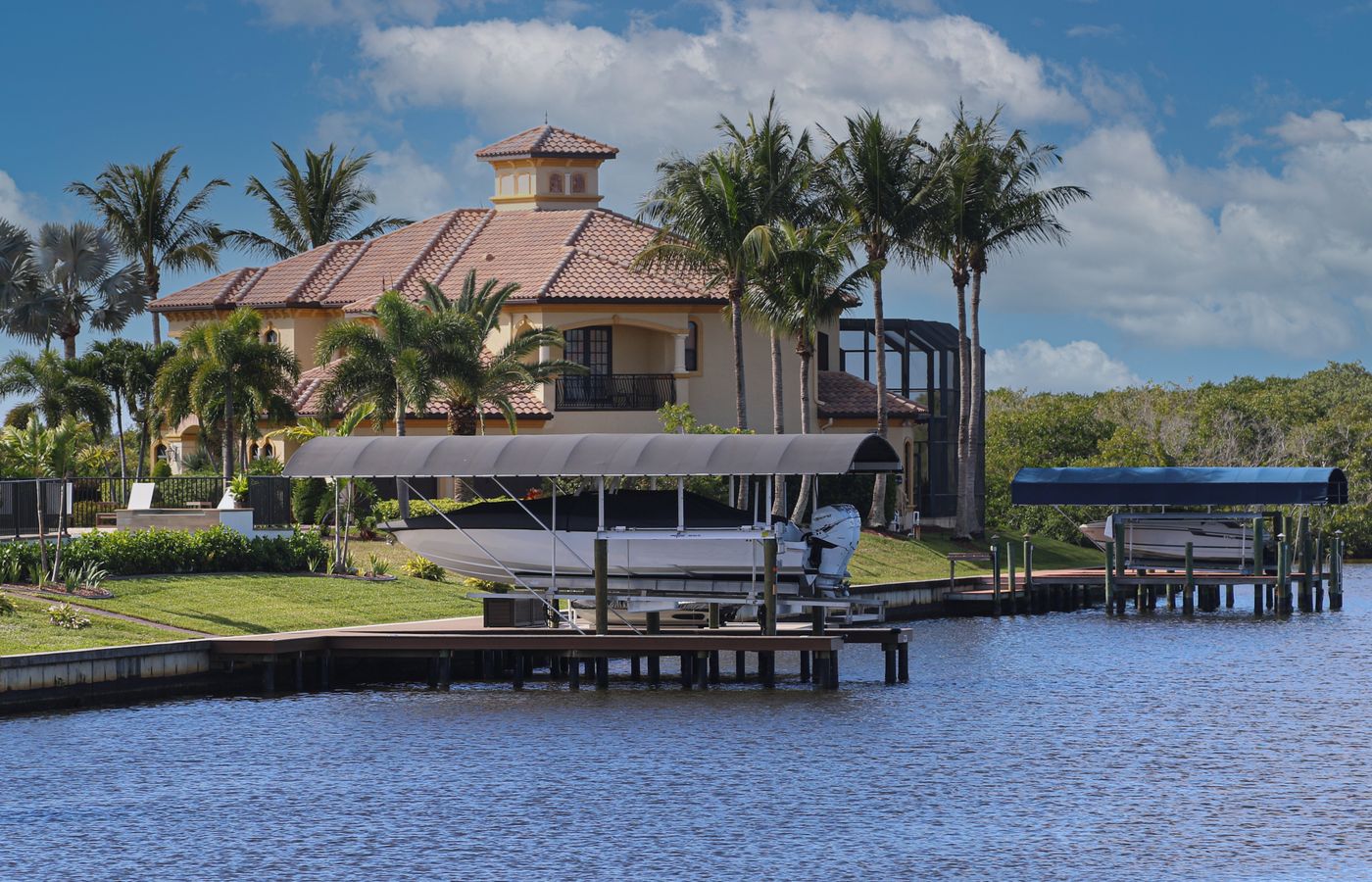
Docks and boat lifts can significantly affect a replacement project because they may occupy the same working area as the seawall.
The project may need to account for:
- dock pilings;
- boat-lift supports;
- electrical service;
- water lines;
- decking attached near the wall;
- access for installation equipment;
- future connection to the replacement wall.
Some structures can remain in place while work proceeds around them. Others may require temporary modification or separate permitting.
Pools, Patios and Landscaping Near the Seawall
Land-side access can be one of the most important practical constraints on a seawall replacement project.
Properties may have:
- swimming pools close to the waterfront;
- screen enclosures;
- patios and pavers;
- retaining walls;
- mature landscaping;
- narrow side-yard access;
- utilities near the wall.
These conditions can influence equipment access, construction sequencing, site restoration and project cost.
Land Access vs. Water Access
Some seawall replacement projects can be approached primarily from land, while others require significant waterside access.
Access planning may depend on:
- yard width;
- neighboring properties;
- canal width;
- water depth;
- bridges or navigation restrictions;
- docks and boat lifts;
- equipment type;
- wall material and installation method.
Do not assume every replacement requires a barge or that water access adds the same cost to every project.
How Much Does Seawall Replacement Cost in Florida?
Seawall replacement cost varies substantially across Florida because replacement projects differ in wall material, height, structural design, site access, water conditions and permitting requirements.
Major cost factors include:
- linear footage;
- wall height and retained grade;
- replacement material;
- anchoring system;
- existing wall condition;
- whether existing components must be removed;
- land-side and water-side access;
- docks and boat lifts;
- pools, patios and landscaping;
- engineering;
- surveys;
- local permits;
- state or federal authorization where applicable;
- site restoration.
This is why multiplying wall length by one generic statewide price-per-foot figure can produce a misleading estimate.
See the detailed Florida seawall cost guide.
Does Seawall Replacement Require a Permit in Florida?
Replacement projects commonly require more permitting review than routine maintenance or limited repair.
Depending on the location and scope, review may involve:
- city or county building and engineering departments;
- Florida environmental resource permitting;
- delegated local environmental programs in some counties;
- water management districts;
- federal authorization for work in regulated waters;
- additional coastal requirements for applicable beach or dune properties.
Florida’s Environmental Resource Permitting program is administered through DEP, water management districts and certain delegated local programs. Qualifying shoreline projects may fall under exemptions or general permits, while others require a different level of authorization.
Federal authorization may also apply to qualifying work in waters of the United States. Florida has programmatic pathways for certain shoreline-stabilization activities, but eligibility depends on the project meeting the applicable conditions.
Properties seaward of Florida’s Coastal Construction Control Line can also be subject to a separate coastal construction permitting framework.
Do not assume that replacing a seawall in the same general location automatically makes the work permit-exempt. The applicable rules should be verified for the specific property and proposed design.
See the Florida seawall permit guide.
Can a Replacement Seawall Be Higher Than the Existing Wall?
Potentially, but allowable elevation depends on the local jurisdiction, structural design, neighboring conditions and any applicable flood or coastal requirements.
Some Florida municipalities have specific minimum or maximum elevations for certain waterfront barriers. Those local standards should not be treated as statewide requirements.
Changing wall elevation can also affect:
- drainage;
- neighboring properties;
- docks;
- finished yard elevations;
- waterfront access;
- permit review.
How Long Does Seawall Replacement Take?
There is no reliable statewide replacement timeline.
Total project duration can depend on:
- survey and engineering requirements;
- permit review;
- wall length;
- wall material;
- site access;
- dock or lift conflicts;
- equipment mobilization;
- weather and water conditions;
- inspection requirements;
- site restoration.
Construction time alone should not be confused with the total time required to design, permit and complete the project.
Can You Replace Only Part of a Seawall?
Sometimes.
Partial replacement may be considered when deterioration is concentrated in one area while adjacent sections remain serviceable.
The transition between old and new sections needs to be considered carefully, including:
- wall alignment;
- structural connection;
- cap continuity;
- different materials;
- support systems;
- potential erosion at the transition;
- future serviceability of the retained wall.
Replacing one failed section is less useful if the remaining wall is already approaching the same condition.
Replacement vs. New Seawall Construction
Replacing an existing seawall and building a new seawall are related but different project types.
| Seawall Replacement | New Seawall Construction |
|---|---|
| An existing waterfront wall is already present | A comparable seawall may not currently exist |
| Existing alignment and structure affect design | New alignment must be established |
| Old components must be addressed | No prior wall may need removal or incorporation |
| Replacement rules may apply | New-construction requirements may apply |
| Docks may already interact with the old wall | Waterfront improvements can be coordinated with the new design |
Learn about new seawall construction in Florida.
Questions to Ask Before Replacing a Seawall
- Why is replacement being recommended instead of repair?
- Which existing components are no longer serviceable?
- Is the wall still moving?
- What material is proposed for the replacement?
- What will happen to the existing wall?
- Will the new wall remain in the same alignment?
- How will the new wall be supported?
- Are docks or boat lifts affected?
- Will pools, patios or landscaping restrict access?
- What surveys or engineering are required?
- Which permits apply?
- What site restoration is included?
- What work is excluded from the proposal?
Should You Get a Seawall Inspection Before Planning Replacement?
Yes, understanding the existing condition is important before assuming replacement is the only practical solution.
An evaluation can help distinguish:
- localized erosion from structural failure;
- cap deterioration from whole-wall deterioration;
- isolated panel damage from widespread deterioration;
- repairable movement from more extensive structural problems;
- a targeted repair project from a true replacement project.
Learn more about Florida seawall inspections.
Request a Seawall Evaluation
If you are considering seawall replacement, start by documenting the condition of the existing wall and the surrounding property.
Helpful information includes:
- property location;
- approximate seawall length;
- existing wall material;
- wall movement or leaning;
- concrete or panel deterioration;
- soil loss;
- previous repairs;
- dock or boat lift present;
- pool, patio or other waterfront improvements;
- clear photographs of the wall and property behind it.
The information can be used to better understand the project and, where available, connect the request with an appropriate marine professional serving the area.
Related Seawall Guides
Seawall Materials
Compare concrete, vinyl, steel, aluminum, timber, riprap and composite seawall systems for Florida conditions.
Read GuideVinyl Seawalls
PVC sheet piling, corrosion resistance, structural limits, caps, tiebacks, repairs and replacement considerations.
Read GuideFlorida Seawall Permits
A practical overview of local, state and federal permitting layers that can apply to Florida seawall work.
Read Guide